
At 13, I thought that because I could read fast, I was understanding everything. I was suffering from the Fluency Illusion—confusing the ease of reading with the mastery of content. It wasn't until I started taking (and then building) quizzes that I realized where my "blind spots" were. Now, as a 17-year-old, I view quizzes not as "tests," but as diagnostic tools for the brain. Meet Sarah. She used to view reading as a solitary, somewhat static chore. Then she discovered the "competitive" side of stories through online book quizzes. Suddenly, she isn't just reading; she’s "scouting" for details like a game show contestant.
"Interactive quizzes leverage a psychological principle known as Retrieval Practice. Unlike rereading, which creates an "illusion of mastery," the act of recalling information from memory strengthens the neural pathways to that knowledge."
The Forgetting Curve and Retrieval Practice
Pedagogical research (specifically by Karpicke & Blunt) highlights that Retrieval Practice, the act of forcing your brain to pull information out - is significantly more effective than rereading.
According to Ebbinghaus’s Forgetting Curve, we lose 70% of what we read within 24 hours. A quiz acts as a "neural reset," forcing the brain to re-index the information.
The "Forgetting Curve" Intervention
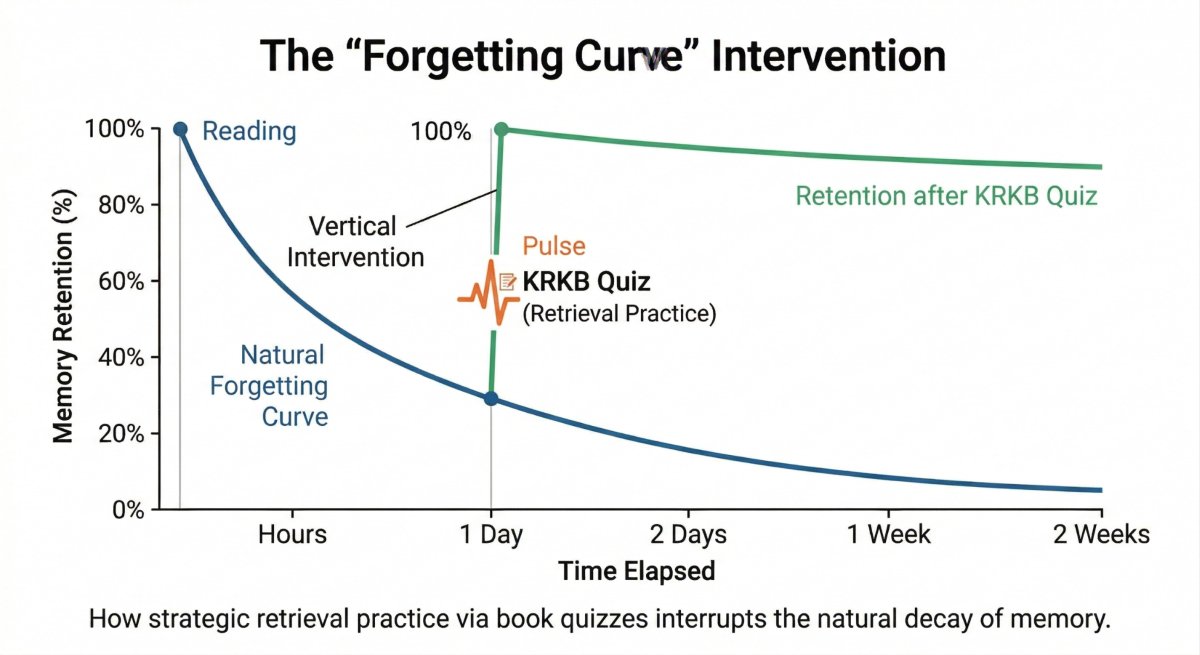
How strategic retrieval practice via book quizzes interrupts the natural decay of memory.
Recognition vs. Recall
Quizzes challenge children to move beyond simple recognition. It’s one thing to remember a character's name; it’s another to remember why they chose the red door over the blue one.
The Dopamine Loop
For a generation raised on instant feedback, the "Score" provides the dopamine hit necessary to tackle "heavier" classics, associating the "hard work" of reading with the "reward" of success.
Diagnostic Literacy
A quiz tells you exactly how you read. Do you miss character nuances? Do you ignore setting descriptions? Quizzes provide a mirror for your own reading habits.
Contextual Vocabulary
Instead of memorizing rote word lists, quizzes place new vocabulary in the heat of a "challenge," making the definitions stick through situational context.
Competitive Mastery

Young adult achieving mastery through interactive book quizzes.
Beyond the Test: Building an Academic Edge
For parents, encouraging this type of gamified literacy is about building Executive Function. It transforms reading from a passive activity into active engagement. By interrupting the decay of memory and gamifying focus, young adults are not just reading books; they are mastering them.
Ready to test your knowledge? Jump into the KRKB Quiz Portal.