
Why Book Quizzes Help Readers Notice What They Miss

At 13, I thought fast reading meant strong reading. If I could move through a book quickly, I assumed I understood it. Then I started taking and building quizzes, and I saw the gap between recognition and recall.
That gap matters. A page can feel familiar while the details are already slipping. Cognitive scientists often describe this as a fluency problem: easy processing can make us overestimate what we know.1 A good quiz interrupts that feeling just long enough to ask, "Can I actually bring the idea back?"
"A quiz is not valuable because it catches a student. It is valuable because it asks the student to retrieve what the book left behind."
Retrieval beats rereading when the goal is memory
The old version of this argument often gets exaggerated with one neat forgetting percentage. I do not want to do that. Memory changes by student, book, time, sleep, interest, and how hard the material was. The useful point is simpler: memory fades when it is never asked to work again.
Retrieval practice gives memory a job. Karpicke and Roediger found that repeated retrieval can support long-term retention more strongly than repeated studying alone.2 Dunlosky and colleagues also rated practice testing as a high-utility learning technique across many learning conditions.1
That does not mean every quiz is automatically good. A quiz full of trivia can miss the point. A better book quiz asks about motive, sequence, evidence, vocabulary in context, and why a scene mattered.
The forgetting curve, used carefully
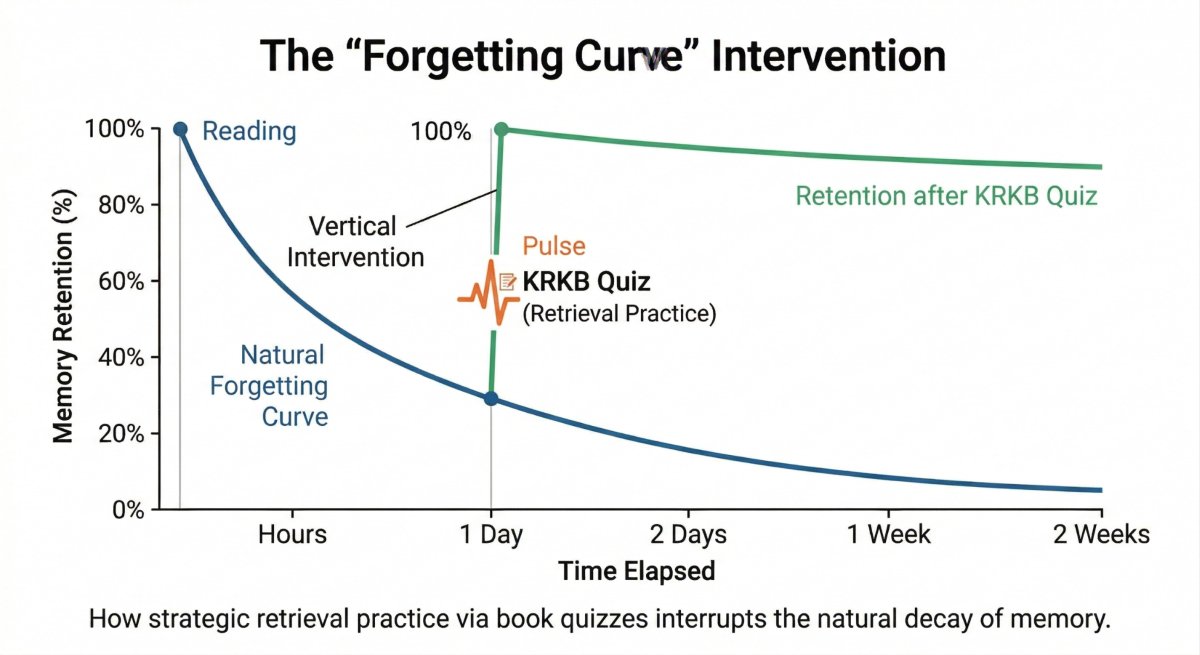
The exact curve is not the point. The school-useful idea is that low-stakes retrieval helps students revisit what they read before it disappears.
Visual source: Gemini Nano Banana generated chart, edited for KRKB. Research basis: Dunlosky et al.; Karpicke and Roediger.
Four benefits of a better book quiz
Recognition becomes recall
It is one thing to recognize a character name on the page. It is harder, and more useful, to remember why that character made a choice.
Feedback arrives early
A short quiz can show a student what to revisit before a misunderstanding becomes permanent.
Comprehension becomes visible
Teachers can see whether students are tracking plot, motive, vocabulary, and theme instead of only seeing that a book was marked complete.
Question writing raises the bar
When students create quiz questions for peers, they have to decide what was important enough to ask.
From quiz score to reading conversation

The best outcome is not a score by itself. It is a student noticing what they understood, missed, and want to discuss.
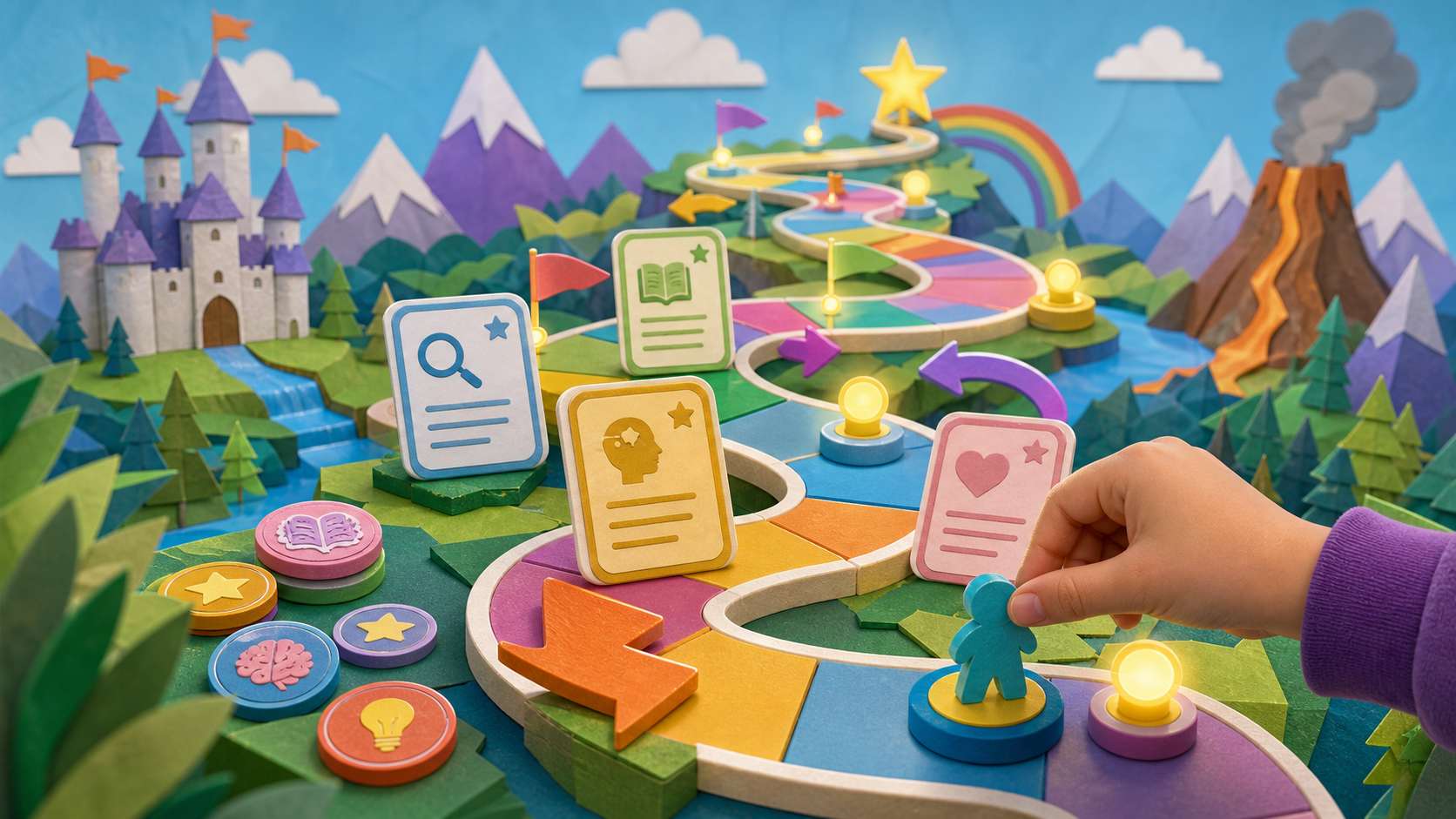
Visual source: OpenAI imagegen generated visual, edited for KRKB.
What this looks like on KRKB
A KRKB quiz should be low-stakes and book-facing. It should help a student check the shape of a story, then return to the book, the review, or the class conversation with a clearer sense of what they know.
The National Reading Panel identified asking and answering questions as one of several comprehension practices that can improve understanding when taught well.3 That is the part I care about most. A quiz should not replace reading. It should make the reading harder to fake and easier to talk about.
Jump into the KRKB Quiz Portal.
Notes
- Dunlosky et al., 2013. The review rated practice testing and distributed practice as high-utility learning techniques and discussed why rereading can feel productive without always producing strong learning. Psychological Science in the Public Interest.
- Karpicke and Roediger, 2008. Their work on retrieval practice supports the idea that recalling information can strengthen later retention more than restudying alone. Science.
- National Reading Panel. The report discusses comprehension strategy instruction, including asking and answering questions, summarizing, monitoring comprehension, and using text structure. Teaching Children to Read.